MentalHealthCE Login


| Login | ||

Healthcare Training Institute - Quality Education since 1979
CE for Psychologist, Social Worker, Counselor, & MFT!!

Section
1
Philosophical and Scientific Foundations
of the Rebranded Manual
Question 1 | Test | Table of Contents
The landscape of clinical psychological classification is undergoing its most radical transformation since the 1980 release of DSM-III. For PhD-level psychologists, clinical researchers, and neuropsychologists, the American Psychiatric Association’s structural blueprint for the next-generation diagnostic framework marks a definitive departure from classical, purely syndromic classification [Regier et al., 2013]. Abandoning the numerical sequential nomenclature of the past, the upcoming manual will not be named DSM-6 [Future DSM Committee, 2025]. Instead, reflecting a profound shift toward empirical, evidence-based science and systemic integration, the manual is rebranded as the Diagnostic and Scientific Manual of Mental Disorders [APA, 2026]. It transitions from a static, heavy printed volume to an online, real-time “living document” [APA, 2026].

The Rebranding: Addressing the Crisis of Validity
The renaming of the manual from Statistical to Scientific represents a calculated, institutional shift designed to address decades of foundational critiques regarding the validity of psychological classification [First & Wakefield, 2023]. While the DSM-5 attempted to lay the groundwork for dimensional tracking, its core infrastructure remained firmly tethered to the traditional categorical tradition: counting clinical symptoms to determine whether an arbitrary diagnostic threshold had been crossed [Kupfer et al., 2012].
The new scientific framework alters the starting point of clinical formulation [Matrix Structural Committee, 2025]. It demands what the Future DSM Committee terms "scientific humility"—an overt acknowledgment of the current limitations of syndromic boundaries and a commitment to continuously align clinical classification with advancements in psychology, neuroscience, and quantitative psychometrics [Future DSM Committee, 2025].
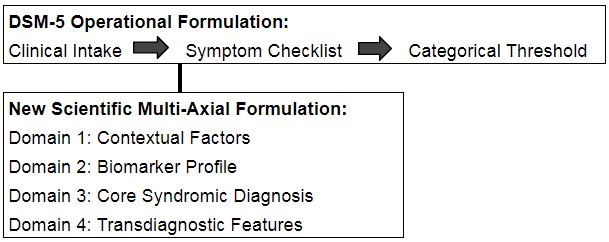
Under the DSM-5 paradigm, diagnostic thresholds were fundamentally driven by consensus-based reliability rather than validity [Regier et al., 2013]. A patient presenting with four symptoms of a major depressive episode was subclinical and administratively distinct from a patient presenting with five symptoms, despite identical levels of functional impairment or psychological distress [Wakefield, 2013]. The rebranded framework rejects this binary, categorical logic [APA, 2026]. By centering the manual on a "Scientific" ethos, the leadership recognizes that mental health conditions are better understood as continuous, overlapping psychopathological dimensions rooted in complex gene-environment interactions rather than discrete, localized disease entities [APA, 2026].
The Transition to a "Living Document" Paradigm
Historically, the operational life cycle of a diagnostic manual was characterized by decades of stagnation punctured by disruptive, monumental overhauls, such as the 19-year gap between DSM-IV and DSM-5 [Kupfer et al., 2012]. This episodic release model created significant friction in clinical practice, research funding, and psychometric calibration [Practice Integration Blueprint, 2026]. Stakeholders received varied timelines of access, disrupting coherence across the field.
The new scientific framework permanently abolishes episodic text overhauls [FDSC, 2026]. Functioning as a cloud-based, centralized digital repository, it operates as a continuous pipeline where updates are deployed as rolling modifications dictated by verified empirical data [APA Digital Initiative, 2026]. For behavioral health practices and electronic health record (EHR) systems, this continuous deployment model shifts the burden of adaptation from manual practice-level updates to platform-level synchronization [Practice Integration Blueprint, 2026]. When a specific clinical trial or large-scale study invalidates a specific trait facet or refines a genetic biomarker profile, the cloud-based manual updates its operational criteria globally, preventing the clinical field from lagging behind laboratory discoveries [APA Digital Initiative, 2026].
References:
American Psychiatric Association. (2026, January 28). APA releases roadmap for the future of the DSM. https://www.psychiatry.org/news-room/news-releases/apa-releases-roadmap-for-future-of-dsm
American Psychiatric Association Digital Initiative. (2026). EHR integration protocols and continuous deployment loops for real-time diagnostic revisions. Science Directorate
First, M. B., & Wakefield, J. C. (2013). Diagnostic criteria as dysfunction indicators: Minimizing false positives in the DSM-5. The Canadian Journal of Psychiatry, 58(12), 663–669.
Future DSM Committee. (2025). Executive report on the structural future of psychological classification: Abandoning sequential numerical iterations. APA Press.
Future DSM Strategic Committee. (2026). Initial strategy for the future of the DSM. The American Journal of Psychiatry, 183(2).
Kupfer, D. J., Regier, D. A., & Kuhl, E. A. (2012). The journey from DSM-IV to DSM-5: Overcoming historical rigidity through empirical expansion. American Psychiatric Association.
Matrix Structural Committee. (2025). Technical specification manual for the Four-Domain Integration Matrix. Scientific Classification Press.
Practice Integration Blueprint. (2026). Clinical workflow manual: Restructuring intake scripts and documentation fields for four-domain matrices. Psychological Practice Management Press.
Regier, D. A., Narrow, W. E., Kuhl, E. A., & Kupfer, D. J. (2013). The conceptual evolution of DSM-5: Balancing reliability with validity in clinical fields. American Journal of Psychiatry, 170(1), 61–70.
New Course 2026
Peer-Reviewed Journal Article References:
Quilty, L. C., Bagby, R. M., Krueger, R. F., & Pollock, B. G. (2021). Validation of DSM–5 clinician-rated measures of personality pathology. Psychological Assessment, 33(1), 84–89.
van Dijk, I., Krueger, R. F., & Laceulle, O. M. (2021). DSM–5 alternative personality disorder model traits as extreme variants of five-factor model traits in adolescents. Personality Disorders: Theory, Research, and Treatment, 12(1), 59–69.
Yalch, M. M. (2020). Psychodynamic underpinnings of the DSM–5 Alternative Model for Personality Disorder. Psychoanalytic Psychology, 37(3), 219–231.
QUESTION
1
By centering the DSM manual on a "Scientific" focus, this recognizes that mental health conditions are what?
To select and enter your answer go to Test.